Is White Water Rafting Safe? Guides, Grades, And Real Risks
White water rafting is a supervised adventure activity run inside a government safety regime, but the risk depends on the river grade, the operator's terms, and your own health and swimming comfort. Here is how the safety system works and how to check your own trip against it.
Short answer
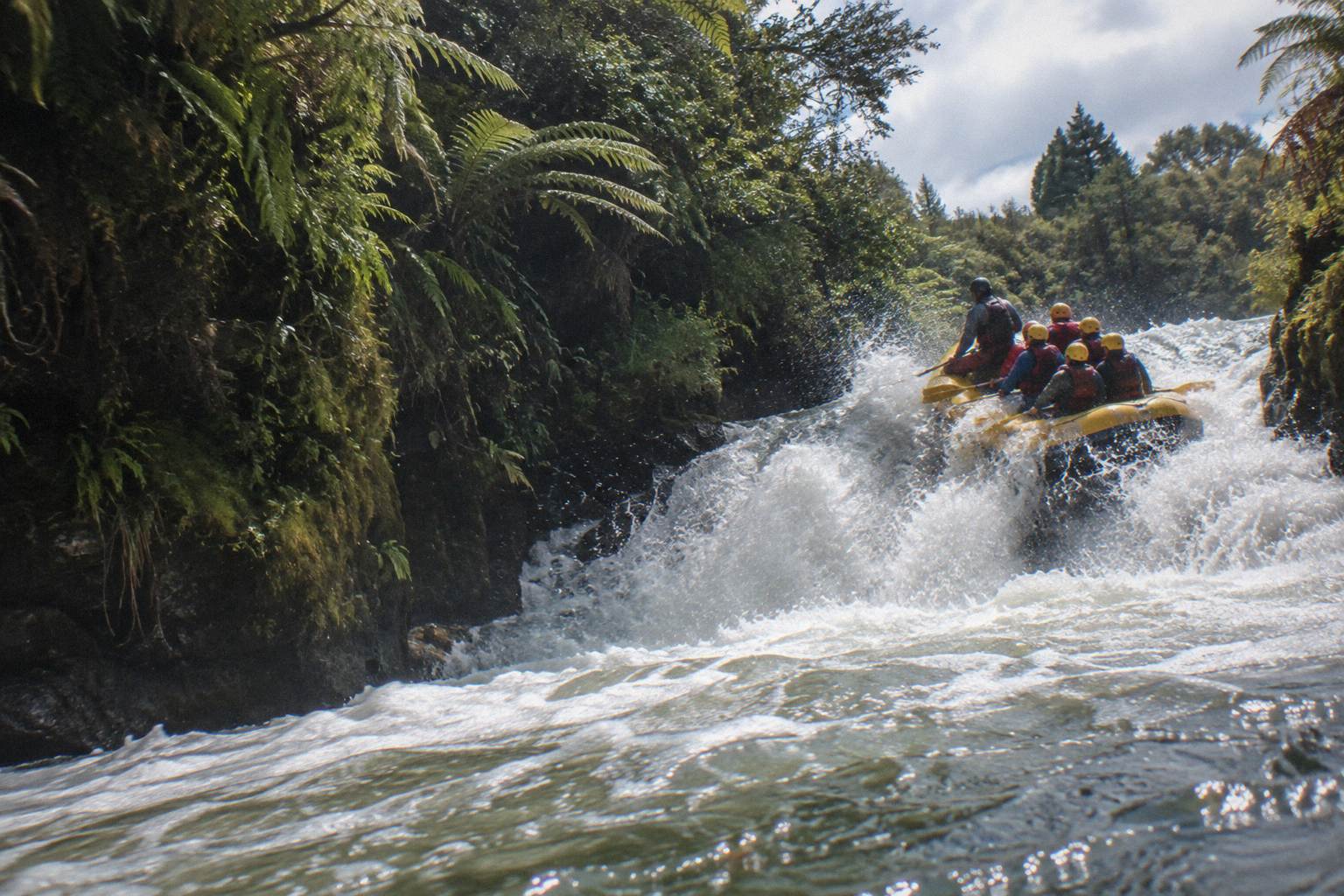
White water rafting is run as a regulated adventure activity: operators in New Zealand must pass a safety audit by a WorkSafe-recognised auditor and register with WorkSafe. Risk still scales with the rapid grade, from gentle Grade 2 water to Grade 5 drops, and each operator sets age, weight and health limits. Read the grade, the kit supplied, and the exclusions before you book.
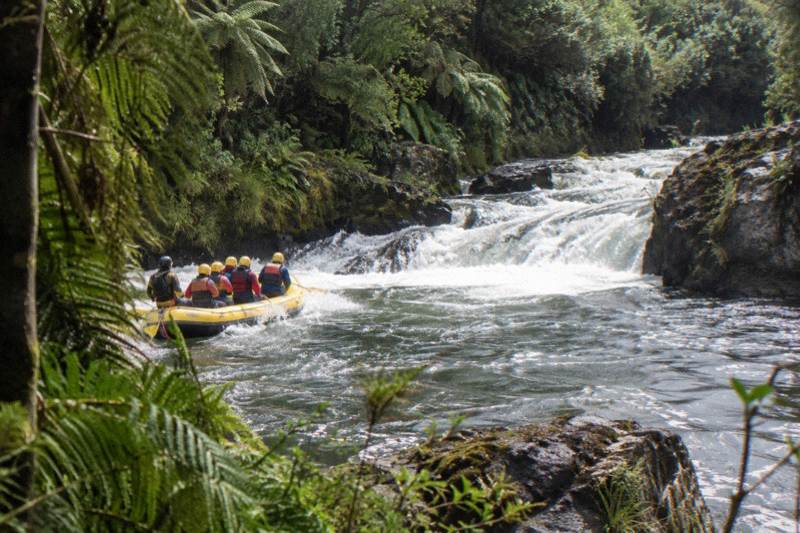
Rafting around Rotorua means one river above all, and every trip sold on this site belongs to the Kaituna River rafting category, where a regulated industry runs daily trips down a council-controlled flow. Before booking any of them, it helps to understand what makes a rafting trip safe or unsafe in general terms, and that is what follows: the audit regime, the grade scale, the kit, and the people who should stay on the bank.
| Fact | Detail |
|---|---|
| Safety regime in New Zealand | Adventure activity operators must pass a safety audit by a WorkSafe-recognised auditor and register with WorkSafe |
| Public register | The WorkSafe adventure activities register lists registered operators |
| Governing rules | Adventure Activities Regulations 2016 |
| Rapid grading scale | The International Scale of River Difficulty, Grade 1 (easiest) to Grade 6 (not run commercially) |
| Kaituna run | Sold as Grade 5, with rapids the Kaituna Cascades blog calls Grade 4 and 5 building to the falls |
| Time on the water | Kaituna Cascades says 50 to 60 minutes on the water, about 2 hours for the whole experience |
| Weight limits (operator-stated) | Kaituna Cascades maximum 120 kg; Rotorua Rafting maximum 130 kg |
| Minimum ages | Per listing: 10 on the Rotorua Rafting listings, 13 on Kaituna Cascades and Kaitiaki Adventures listings |
Is White Water Rafting Safe For A First Timer?
For a reasonably healthy adult who can swim a little, a guided commercial rafting trip sits in the same broad risk band as other supervised adventure activities: not risk-free, but heavily managed. Three things carry the safety load: a government audit regime the operator must pass, the grade of water you choose, and the kit and guide the operator supplies. Control those three and the residual risk is the water itself.
Start with what rafting actually is: a group sport on moving water, in a raft, with a trained guide calling paddle strokes. The Wikipedia entry on rafting describes the basic practice, and it is worth reading because the sport's own conventions, paddling together, listening to the guide, bracing in the rapids, are the foundation everything else builds on. A commercial trip adds a second layer on top: the operator's equipment, briefing and river-reading.
For first-timers specifically, thousands of people run commercial trips each year without injury, and the industry is structured so that a beginner never has to judge the river alone. The guide chooses the line, the operator chooses the flow and the launch window, and the audit regime checks that the operator's systems work. The beginner's job is narrower: disclose health and swimming ability at booking, listen to the briefing, and wear the kit properly. If you want the full first-timer checklist, the beginner's white water rafting guide walks through every step from booking to the take-out.
What a beginner should not do is treat the grade as decoration. A Grade 5 trip and a Grade 2 trip are different products with different demands, and the safety question changes with them. That grade scale, and the audit regime behind every operator, are the next two pieces.
Who Checks That A Rafting Operator Is Safe?
The practical move is simple: before you pay, look the operator up on the WorkSafe adventure activities register. A registered operator has been through an external audit of its safety system, its risk management, its equipment regime and its staff competencies, by an auditor WorkSafe recognises. General background on the regime is on the WorkSafe adventure activities page, and the rules themselves sit in the Adventure Activities Regulations 2016.
What the audit regime does not do is promise outcomes. It checks that the operator's systems are sound, that guides are competent for the water they work, and that hazards have been identified and controlled. The river still decides the flow, the weather still decides the day, and the booking calendar still decides what runs. That is why the rules on this site's pages always come back to the operator's own terms rather than blanket assurances.
| Risk control | How it works | Who provides it |
|---|---|---|
| Safety audit | External audit of the operator's safety system by a WorkSafe-recognised auditor | The regime, under the Adventure Activities Regulations 2016 |
| Public registration | Operators appear on a searchable register customers can check | WorkSafe |
| Guide competence | Audited as part of the operator's safety system | The operator, checked by the audit |
| Supplied kit | Wetsuits, helmets, life jackets, fleece, booties, splash jacket on the Kaituna | Rotorua Rafting and Kaituna Cascades list these as supplied |
| Pre-launch briefing | Rehearses paddling on command, holding on in drops, the swimmer drill | The operator's guide at the base |
| Screening terms | Minimum ages, weight ceilings, health exclusions, possible float test | Each operator, per its own terms |
| Flow control | Council-controlled gates at the Lake Rotoiti outlet hold the Kaituna's flow | The council-controlled gate system |
For a river-specific picture, the question of whether Kaituna rafting is safe has its own page, because that river's conditions, controls and history deserve their own treatment rather than a paragraph here. The short version: the Kaituna is a high-grade run managed daily by audited operators, and its safety story is about flow control and operator practice.
One habit worth forming: when you compare trips, compare registered operators on their own terms. Registration is the floor, not the differentiator. The real differences between trips are grade, duration, what is supplied, and who the trip excludes, and those are printed by each operator for each product.
How Do Rapid Grades Change The Risk?
The grade of a rapid, on the International Scale of River Difficulty, is the fastest way to size up a trip's demand: Grade 1 is moving flat water, Grade 2 has small waves and clear lines, Grade 3 adds irregular waves and manoeuvring, Grade 4 needs precise paddling in powerful water, and Grade 5 is the top commercial grade. Grade 6 is not run commercially. Higher grade means less margin for error.
The Wikipedia entry on whitewater covers the scale in full, and it is worth ten minutes of any booking evening, because the grade tells you what the water will ask of you before any brochure does. A Grade 2 trip is a family product: small waves, forgiving lines, space to correct mistakes. A Grade 5 trip is a different sport. The water is powerful, the moves are set by the river rather than chosen, and the guide's calls are instructions, not suggestions.
The Rotorua area spans the range. The Kaituna run is sold as Grade 5, and the Kaituna Cascades blog describes its rapids as Grade 4 and 5 building to the falls, which matches the listing: the hardest single feature is the waterfall, and the water before it is serious but not uniform. The Wikipedia entry for the Kaituna River gives the river's context. At the gentler end, the Grade 2 Rangitaiki product from Rotorua Adventures Kayak and Raft takes children from age 5 on its listing, from NZ$125 per person for a 4 hour experience with 1.5 hours on the water.
Grade also interacts with swimming ability. On Grade 2 water, a swim, the rafting word for falling out, is usually short and calm. On Grade 5 water, the operator's briefing matters more, because the recovery drill is specific and rehearsed. Every Kaituna operator briefs that drill before launch, and listening to it is the single most useful thing a paddler contributes to their own safety. If the worry of coming out of the raft is what holds you back, the page on what happens if you fall out of the raft covers the drill in detail, including why a well-fitted lifejacket and helmet are the two pieces of kit that matter most.
What Safety Kit Do Operators Supply?
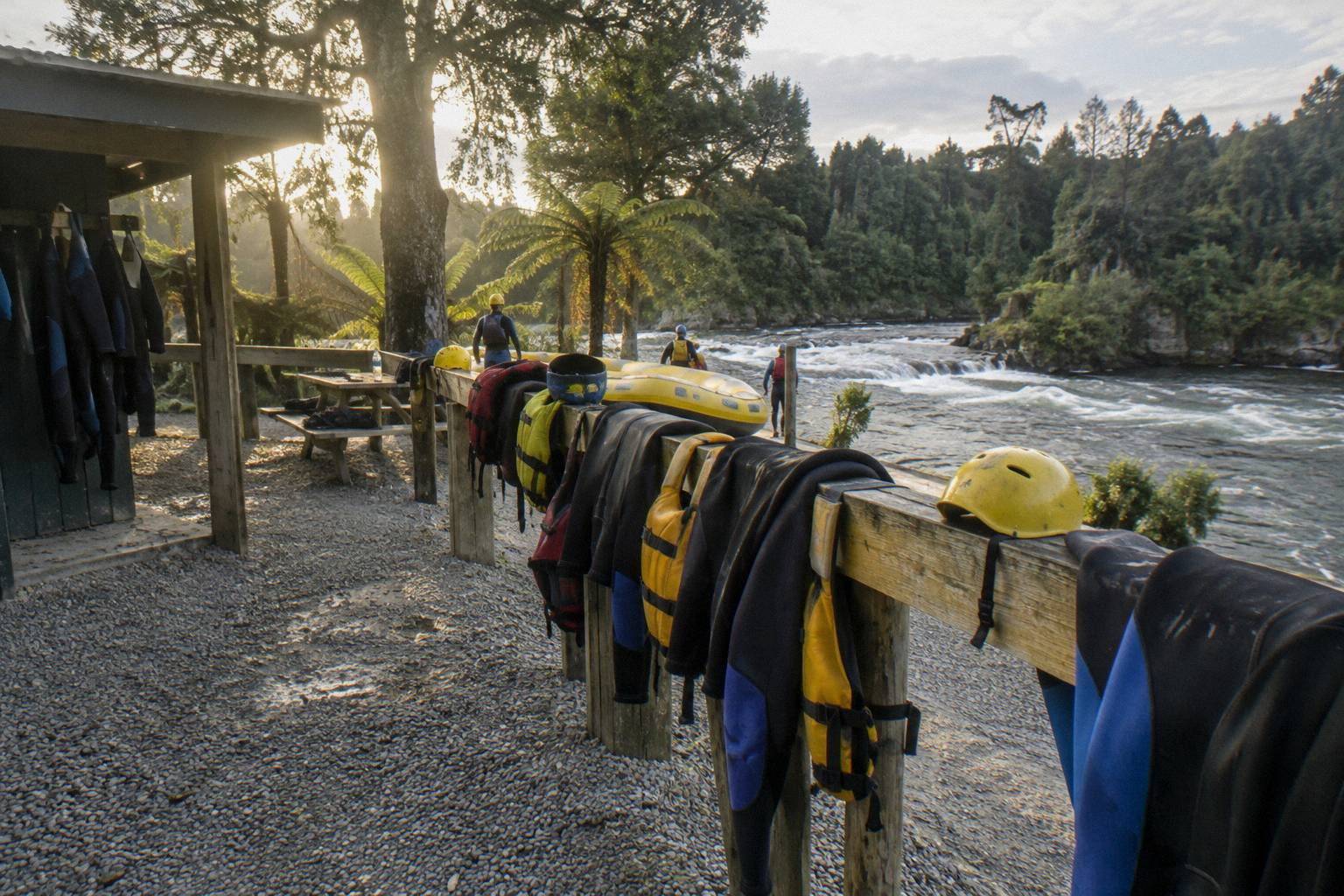
On the Kaituna, the operator supplies the technical kit: the Rotorua Rafting and Kaituna Cascades pages both list wetsuits, helmets, life jackets, fleece, booties and a splash jacket as provided. That covers warmth, flotation and head protection, the three things a rafter cannot improvise. What you bring is small: Kaituna Cascades says swimwear and a towel. The kit is the operator's audited safety system worn on your body.
Every piece on that list solves a specific problem. The wetsuit and fleece manage cold: the water runs about 24 degrees C in summer and about 12 °C in winter by the operator's FAQ figures, and cold water dulls judgement long before it becomes dangerous on its own. The life jacket keeps a swimmer up. The helmet protects the one part of the body rocks do not forgive. Booties protect feet on the bank and in the water, and the splash jacket cuts wind chill on the paddle back. Nothing in that list is optional in practice; if an item does not fit, say so at the base, before the bus leaves.
| Kit item | What it does | Who supplies it |
|---|---|---|
| Helmet | Head protection against rocks and paddle contact | Rotorua Rafting and Kaituna Cascades both list it as supplied |
| Life jacket | Flotation if you enter the water | Rotorua Rafting and Kaituna Cascades both list it as supplied |
| Wetsuit | Warmth in cold water | Rotorua Rafting and Kaituna Cascades both list it as supplied |
| Fleece | Extra insulation under the wetsuit | Listed as supplied on both operator pages |
| Booties | Foot protection on the bank and in the water | Listed as supplied on both operator pages |
| Splash jacket | Wind and spray shell over the wetsuit | Listed as supplied on both operator pages |
| Swimwear and towel | Worn under the wetsuit, and for after | You bring these, per the Kaituna Cascades page |
What you wear under and around that kit matters too, and the answers are not obvious: the pages on what to wear white water rafting and what to bring white water rafting cover layering, footwear rules and the small items that make the day comfortable. One camera note from the operator terms: Rotorua Rafting allows GoPro mounts on its helmets, so a hands-free camera is possible without compromising the kit.
The flagship Rotorua Rafting sauna product, "Free Sauna, 2h30 Kaituna Trip", runs 5.0 from 2,191 reviews from NZ$135 per person with a minimum age of 10 on that listing, and its post-trip sauna sits well with the cold-water arithmetic above: warm kit in, warm room after. Its twin product, "Free Sauna, 2h Kaituna Run", is a separate bookable product from NZ$74 per person on its own card.
Who Should Not Go Rafting?
Operator terms exclude some people outright. Kaituna Cascades states its trip is not for pregnancy or heart conditions, sets a minimum age of 13 on its listing (ages 10 to 12 join halfway along the run), a maximum weight of 120 kg, and says a float test may be required. Rotorua Rafting sets a maximum weight of 130 kg, and its listings show a minimum age of 10. These are health screening rules, not fine print.
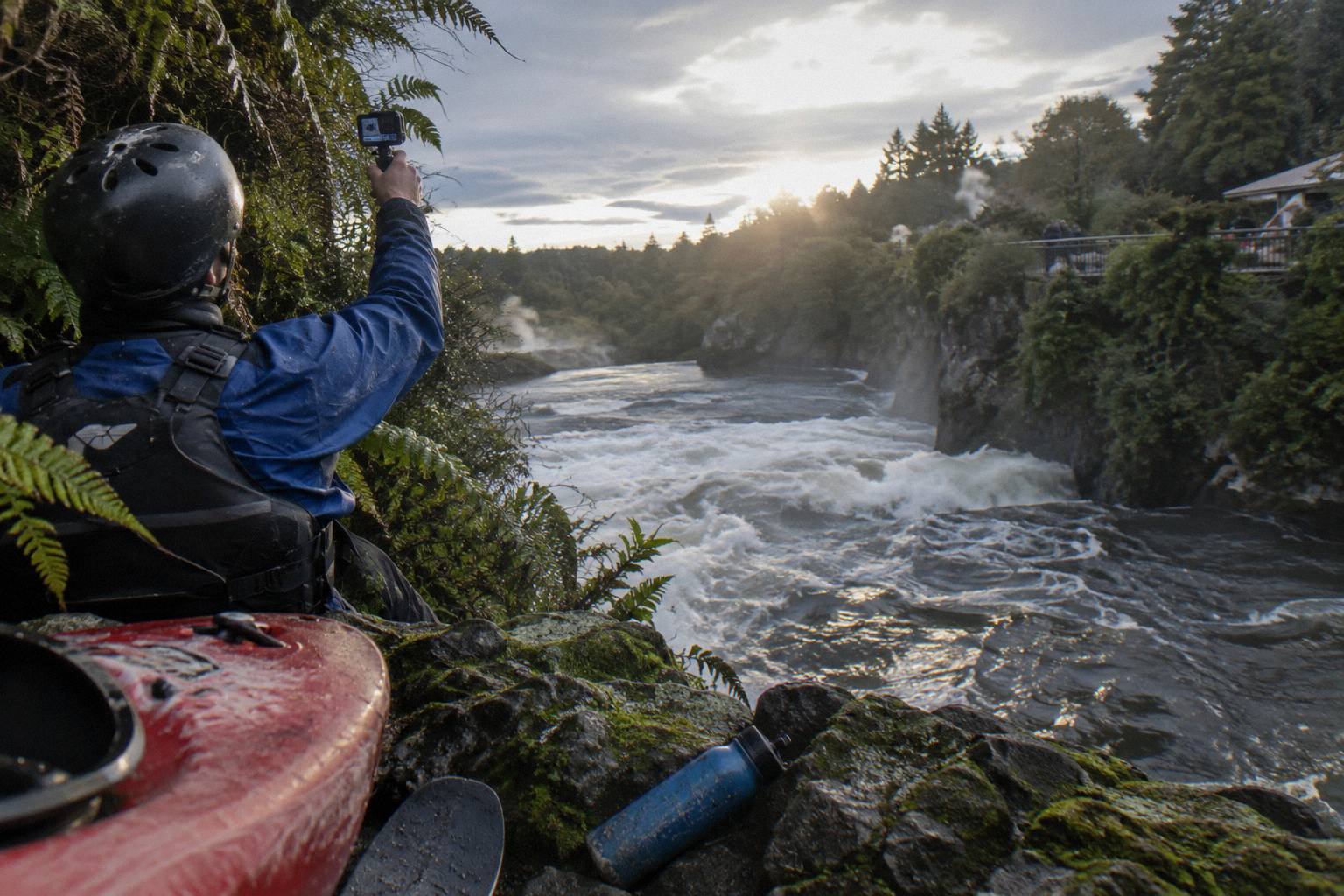
The float test deserves a plain explanation, because the phrase alarms people. It is a short check, in calm water, in the supplied kit, that you can float and self-manage in the water before the trip takes you into rapids. If an operator's terms say one may be required, expect to be asked and treat it as the safety check it is. Being able to swim is the underlying question, and the page on whether you need to swim to go rafting answers it directly: ability requirements scale with the grade.
| Who the terms exclude | The operator's stated rule |
|---|---|
| Pregnancy | Kaituna Cascades: not for pregnancy |
| Heart conditions | Kaituna Cascades: not for heart conditions |
| Under 13 on the Kaituna (Kaituna Cascades and Kaitiaki listings) | Minimum age 13 per listing; Kaituna Cascades says ages 10 to 12 join halfway along the run |
| Under 10 on the Rotorua Rafting listings | Minimum age 10 printed on those listings, not an operator-wide rule |
| Over 120 kg (Kaituna Cascades) | Maximum weight 120 kg on its Kaituna terms |
| Over 130 kg (Rotorua Rafting) | Maximum weight 130 kg on its terms |
| Anyone who cannot complete a float test | Kaituna Cascades: a float test may be required |
Checking pickup details before you book prevents most avoidable problems. Operators ask about health, swimming ability, weight and age when you book, and the correct move is to answer in full rather than hope the rapid is kind. A heart condition that is fine on a walking track is a different matter in cold, aerated water. Disclosures are not used to embarrass anyone; they let the operator steer you to the right product, sometimes a gentler river grade altogether.
Families should note the age arithmetic carefully, because it varies by product even on the same river. The Kaituna Cascades listing is 13-plus with the halfway join option for 10 to 12 year olds, the Rotorua Rafting listings print 10, and the Kaitiaki Adventures listings print 13. The wider question of white water rafting with kids collects the figures in one place.
The Kaituna Cascades product "Kaituna Cascades, The Originals" runs 5.0 from 1,385 reviews, from NZ$135 per person, 2 hours, minimum age 13 on its listing, and its terms are the ones quoted throughout the table above. If any row of that table touches you, ask the operator before booking rather than after.
Do Guides And Briefings Make Rafting Safer?
Yes, and more than any single piece of kit. The guide is the trip's risk manager on the water: they read the line, set the pace, call the paddle strokes, and decide in the moment whether conditions match what was booked. The briefing rehearses the three drills that matter, paddling on command, holding on in the drops, and the recovery position if you swim. Under the WorkSafe regime, guide competence is part of what the audit examines.
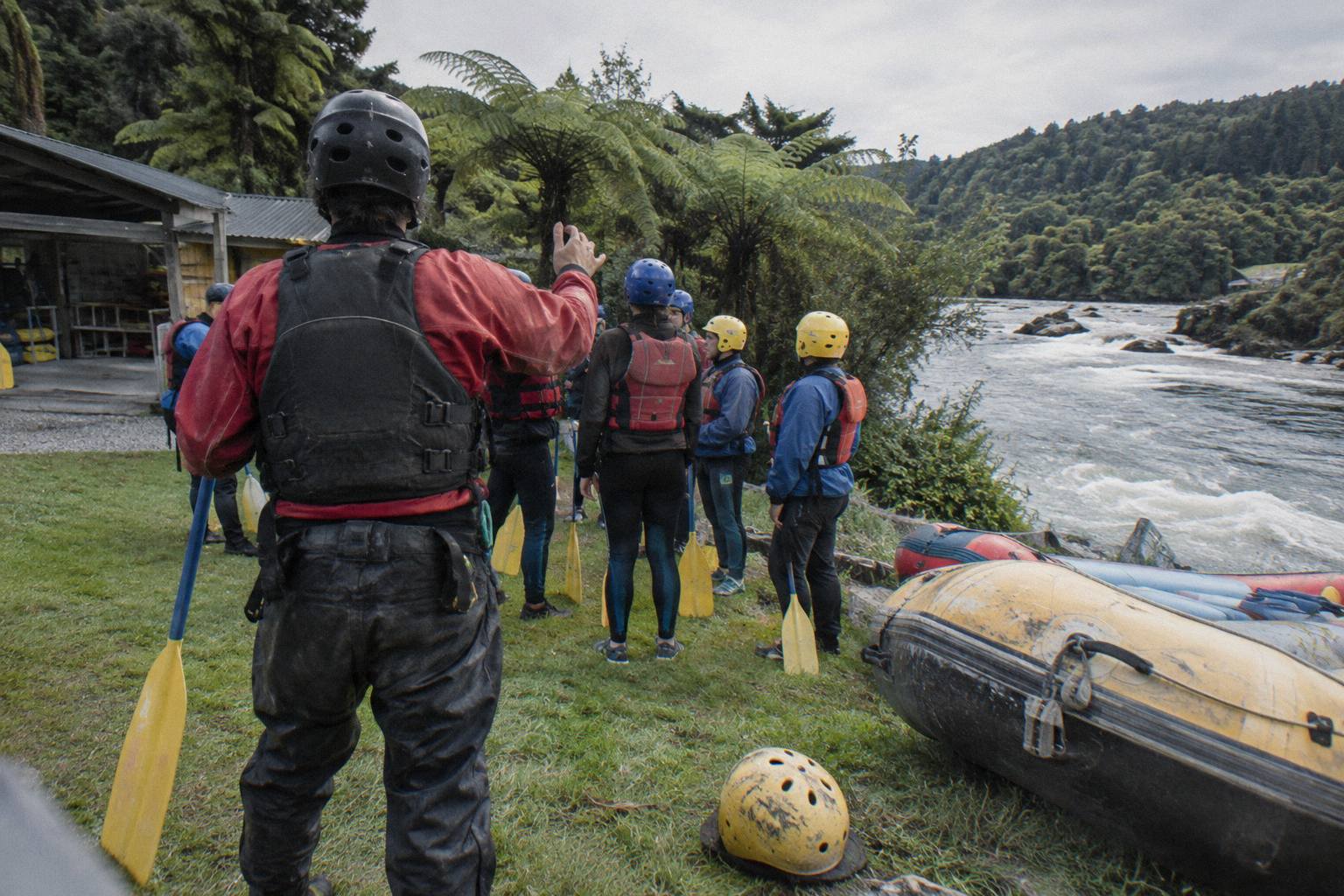
A commercial raft is not a democracy once it is on the water. The guide's calls come first and immediately, and the briefing's first job is to make that reflexive: when the guide says paddle forward, everyone paddles forward, in time, together. The second job is the hold-on drill at the drops, and the third is the swimmer drill, float on your back, feet up and pointed downstream, feet toward the safety kayak or the eddy, never try to stand in moving water. Rehearsing those three on the bank is why a group of strangers functions as a crew within minutes.
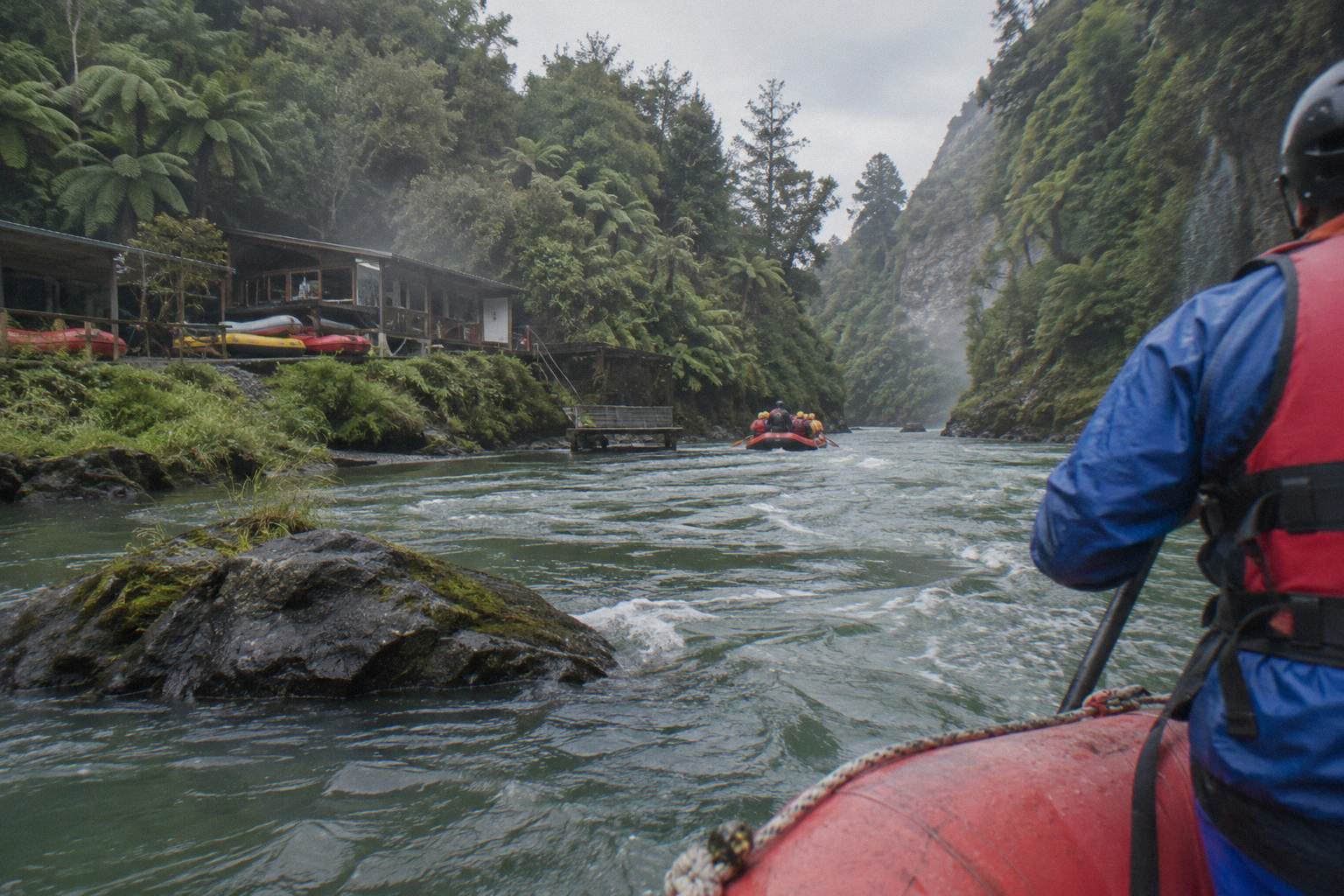
The check-in routine is part of the same system. Kaituna Cascades asks customers to check in 15 minutes early, and that margin is where kit fitting, the briefing and the float test, if required, actually happen. Arriving rushed compresses all three. The geography helps too: the put-in and base are at Okere Falls, which the Kaituna Cascades page puts at 23 minutes from Rotorua, with its base at 18 Okere Falls Road offering free parking and direct river access, so the journey to the water is short and unhurried.
Getting to the water in the first place is its own small safety factor, and one product removes it entirely: "Rafting With Hotel Transfers" from Kaitiaki Adventures Aotearoa includes free hotel pickup on that product, runs 5.0 from 823 reviews, from NZ$139 per person for 2h30, minimum age 13 on its listing. See the rafting with hotel transfers tour page for dates and pickup terms, or check availability if the transfer version suits your plans. Its twin, "Kaituna Rafting, Free Pickup, 2.5h", is a separate product from NZ$61 per person on its own card.
What Does A Safe Trip Look Like On The Day?
A well-run day has a visible rhythm: a check-in with time to spare, a kit fitting where someone checks your helmet strap and life jacket, a briefing that rehearses the swimmer drill rather than rushing it, and a guide who reads the water and the group before the first rapid. Kaituna Cascades describes its run as 50 to 60 minutes on the water inside about 2 hours all told, 14 rapids and drops and 3 waterfalls.
The river itself is unusually cooperative by rafting standards, which is not luck. Council-controlled gates at the Lake Rotoiti outlet hold the Kaituna's flow, and that is why the river runs 365 days a year while other rivers wait for rain or a release. Kaituna Cascades publishes river conditions on its own pages, and its spring 2026 update reported flows in the 500s on the control gates and water at 19 degrees C, with the big waterfall described as more powerful but slightly less tall and vertical at that flow.
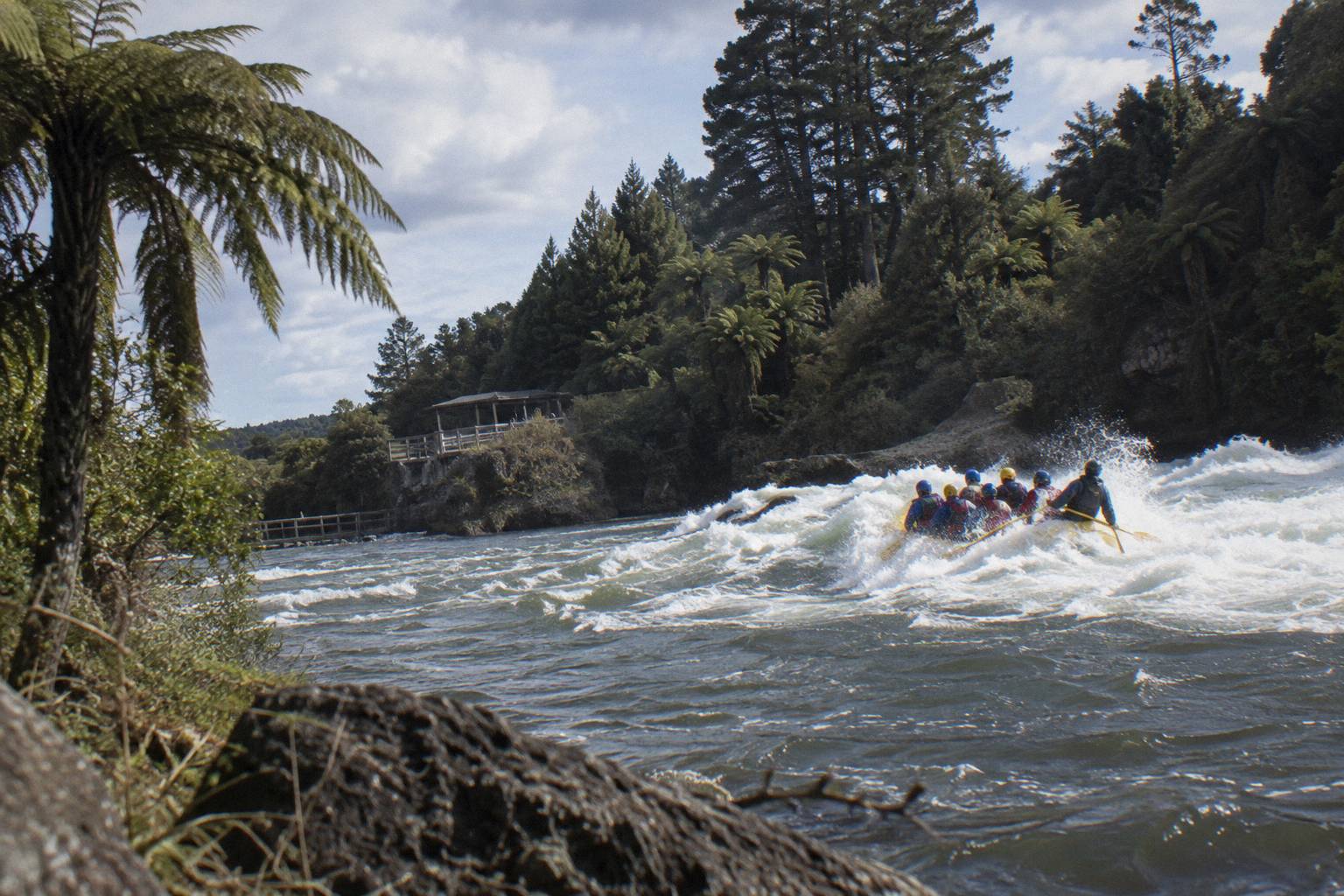
Flow changes the character of a run, which is the short answer to anyone asking whether the same trip is equally safe year-round. A high-flow day is a bigger, faster version of the same rapids; a lower-flow day exposes more rock and asks more precise lines. Neither is unsafe for a guided commercial trip, but they are different days, and the guide adjusts for both. Seasonal questions have their own page in the month-by-month Kaituna rafting season guide, and rain specifically is handled in whether rain cancels a rafting trip.
After the water, the day unwinds at the base, and on the two sauna products from Rotorua Rafting that includes the free sauna in the product name. Warming up deliberately after cold-water paddling is more than comfort, it closes the day the way the briefing opened it, with the body looked after. That post-trip half hour, towel in hand, is also when to raise anything about the kit or the guide with the base staff, while the day is fresh.
What Trips People Up Before You Book
Most rafting bookings go wrong in the same few ways: choosing a grade that does not match the group, missing a minimum age by a birthday, ignoring a weight or health term until check-in, and booking the cheapest card without reading which product it actually is. Every one is avoidable in five minutes: read the grade, check the ages and weights against the people going, answer the health questions fully, and compare listings by what they include.
The twin-product trap deserves a special mention, because it catches careful readers too. Several Kaituna trips on this site exist as two separate bookable products from the same operator, sold on different booking pages with different durations and different from-prices. They are never one product at two prices. The 2h30 sauna trip from NZ$135 and the 2h sauna trip from NZ$74 are different cards with different inclusions of time; both the Kaitiaki trip at NZ$139 and the Kaitiaki trip at NZ$61 include free hotel pickup, and differ in duration and inclusions. Read the card you are actually booking, and if a duration, pickup or sauna inclusion matters to your day, confirm it is on that card before you pay. Check the live price on the booking page for your date, because amounts vary by date and group.
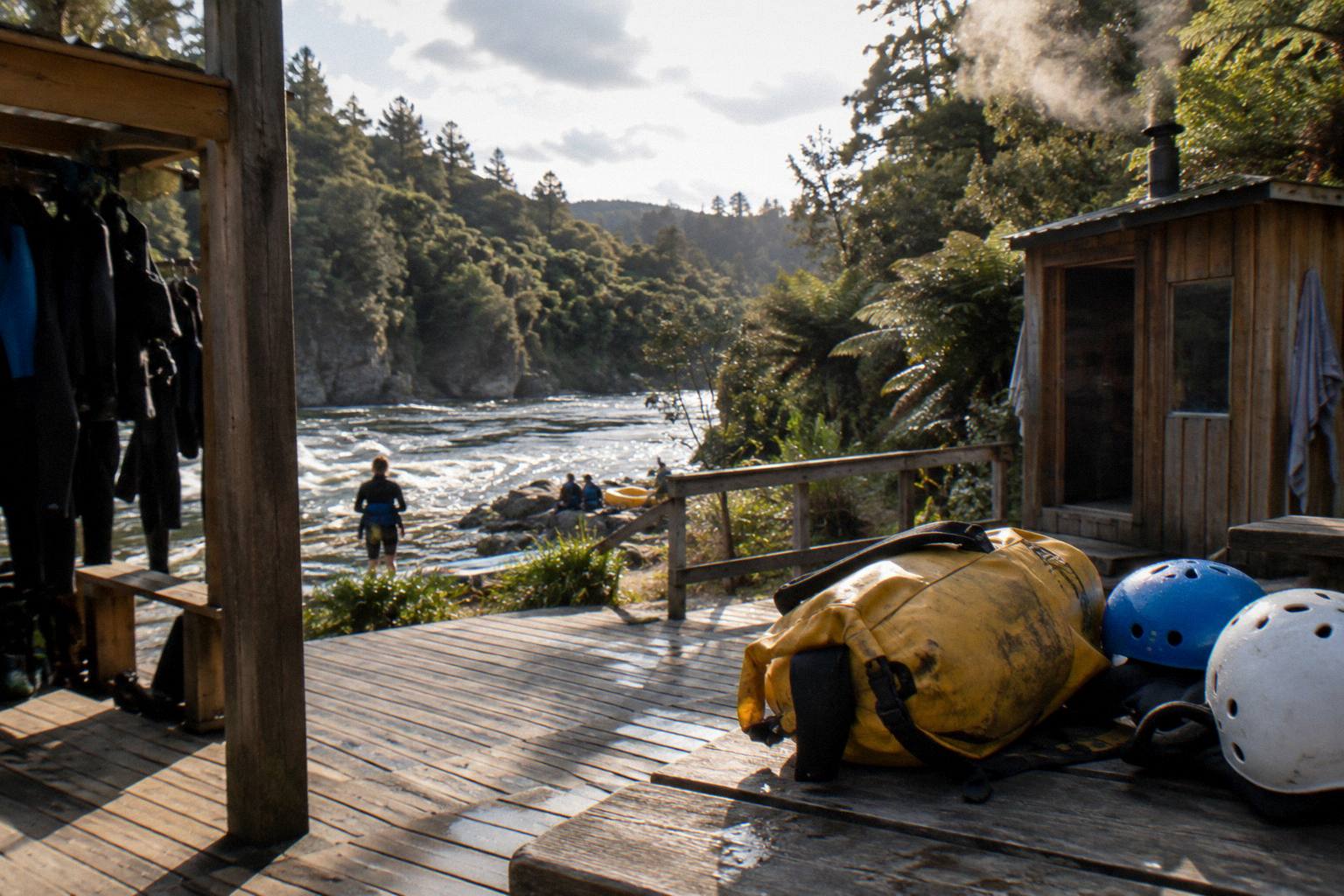
The health questions deserve the same seriousness at booking as at the riverbank. Pregnancy and heart conditions are stated exclusions on the Kaituna Cascades terms, and the weight ceilings of 120 kg and 130 kg are per operator, not interchangeable. A quick family arithmetic check also pays: with minimum ages of 13 on the Kaituna Cascades and Kaitiaki listings and 10 on the Rotorua Rafting listings, a family with a 12 year old has options, but only on the products whose listing allows them, and the halfway join for 10 to 12 year olds is a Kaituna Cascades arrangement on its run. When in doubt about any term, ask the operator directly before booking, once, and the booking calendar shows dates and times.
A last habit that costs nothing: after a trip is booked and before the day, re-read the operator's own FAQ and terms pages. Rafting Rotorua keeps its guides updated, but the operator's page is where the final word on kit, ages and check-in lives, and it is the version the crew on the day will be working from.
Common Questions About Rafting Safety
Is White Water Rafting Safe?
Run by a registered operator on an appropriate grade, commercial rafting is a managed adventure activity, not a gamble: New Zealand operators must pass a WorkSafe-recognised safety audit and register with WorkSafe. Risk scales with the grade of water, from gentle Grade 2 to Grade 5, and each operator's age, weight and health terms screen for who the water suits. Read the grade and the terms before you book.
Is White Water Rafting Safe For Beginners?
Yes, on the right product. A beginner should start on a grade matched to their swimming comfort and health, listen to the briefing, and wear the supplied kit correctly. The Kaituna's Grade 5 run takes beginners daily with a guide in every raft, while gentler grades such as the Grade 2 Rangitaiki product, minimum age 5 on its listing, suit families and nervous first-timers.
Is White Water Rafting Safe If You Can't Swim?
It depends on the grade and the operator's terms. You wear a life jacket and helmet the whole time, and the briefing rehearses the swimmer drill, but higher grades assume you can self-manage in moving water, and Kaituna Cascades says a float test may be required. Mention your swimming ability at booking and the operator can steer you to a suitable trip. Grade 1 and Grade 2 water, on the International Scale of River Difficulty: small waves, clear lines, and room to correct mistakes. The Grade 2 Rangitaiki product from Rotorua Adventures Kayak and Raft takes children from age 5 on its listing. Higher grades ask more of the paddler, which is why minimum ages rise with the water. By operator terms: anyone pregnant or with a heart condition, on the Kaituna Cascades exclusions; anyone over the operator's weight ceiling, 120 kg for Kaituna Cascades and 130 kg for Rotorua Rafting; and anyone under the listing's minimum age, 13 on the Kaituna Cascades and Kaitiaki listings, 10 on the Rotorua Rafting listings, with ages 10 to 12 joining halfway on the Kaituna Cascades run. On the Kaituna, the Rotorua Rafting and Kaituna Cascades pages both list wetsuits, helmets, life jackets, fleece, booties and a splash jacket as supplied. You bring swimwear and a towel, per the Kaituna Cascades page. If any item does not fit at the base, say so before launch so it can be swapped.What Is The Safest Rafting Grade?
Who Should Not Go White Water Rafting?
What Safety Equipment Is Provided For Rafting?