Is Class 3 Or Class 2 Harder Rafting?
Class 3 is harder than Class 2 on the International Scale of River Difficulty. Here is what changes between the two grades and where each sits among Rotorua's rafting products.
Rafting grades decide a lot about how a day on the water feels, and the gentlest end of the scale is where families and first timers usually start. If the question is which of the two lower classes is harder, the Rangitaiki and Wairoa rafting trips collection is the natural place to see the difference in real products: one listing on it is sold at Grade 2, while another river in the same region runs at Grade 5 on release days.
| Fact | Detail |
|---|---|
| The direct answer | Class 3 is harder than Class 2 |
| The scale | International Scale of River Difficulty, six classes |
| Class 2 water | Straightforward rapids, wide clear channels, easy waves |
| Class 3 water | Moderate irregular waves, narrow passages, possible swamping |
| Grade 2 trip | Rangitaiki listing from Rotorua Adventures Kayak and Raft, minimum age 5 |
| Kaituna as sold | Grade 5, 14 rapids and drops, 3 waterfalls |
| Time on the Kaituna water | About 50 to 60 minutes |
Yes, Class 3 is harder than Class 2, without much argument. The International Scale of River Difficulty places Class 2 at straightforward rapids with wide, clear channels that are obvious without scouting, while Class 3 sits a full step up, with moderate, irregular waves that may be difficult to avoid and can swell into a raft. Class 2 asks only for basic paddling; Class 3 demands tighter lines and quicker commands.
The scale runs from Class 1, which is moving water with ripples and almost nothing to manoeuvre around, up to Class 6, which is considered unrunnable except at favourable water levels. Each step is meant to describe the difficulty of the rapid itself rather than the danger, though the two usually travel together. The Wikipedia entry for whitewater lays out the full International Scale of River Difficulty, and its wording on the two classes in question is worth reading directly: Class 2 rapids need some trained manoeuvring, Class 3 rapids need complex manoeuvring in strong currents and may involve large, unavoidable waves.
What the numbers hide is that the jump is not perfectly uniform. A clean, pool drop Class 3 with big forgiving eddies can feel calmer than a continuous, rocky Class 2 in a loaded raft at high flow. Rapids are also graded at normal water levels, and the same rapid can read a grade easier or harder after rain or a release. That is why operators describe rivers as they run them rather than handing over a single number and leaving it there.
For anyone comparing these two grades as a first rafting decision, the practical split is simple. Class 2 suits families, nervous beginners and anyone who wants scenery with their splashing. Class 3 suits reasonably confident swimmers who are fine being bounced around and told to paddle hard on command.
What The Scale Actually Measures
The six international classes grade the difficulty of the water itself, not the quality of the trip or the fitness of the paddler. A rapid is rated on its waves, drops, rocks, channel width and the manoeuvring needed to run it clean at typical levels, so a Class 2 rapid with a joke name stays Class 2 and a Class 5 wave train earns its number even when a skilled crew makes it look routine.
Grades attach to individual rapids as often as to whole rivers, which is why a single stretch can be described two ways. A river might be sold at its hardest rapid's grade even when most of the run is milder, or an operator might describe the same river by the mix of grades along it. Both descriptions can be true at once, which is exactly what happens on the Kaituna: Kaituna Cascades sells the run as Grade 5, while the company's own blog describes the rapids as a mix of Grade 4 and Grade 5 building towards the waterfall at the end.
The scale also says nothing about water temperature, remoteness or access, all of which change how a trip feels. A warm, roadside Class 3 with help nearby is a different day from a cold, wilderness Class 3 an hour from the road. The Wikipedia entry for rafting covers how commercial operators manage these factors with guides, equipment and trip structures, and it is a useful reminder that the grade is only one input into the experience an operator builds around it.
Thinking about the scale as a ladder rather than a verdict helps. Nobody needs to climb it, and plenty of rafters happily run Class 2 and Class 3 water for decades. But knowing which rung a trip sits on tells you what the day will demand before you ever see the put-in.
What Changes Between Class 2 And Class 3 Water
Three things change stepping from Class 2 to Class 3: the waves get irregular and can swamp the raft, the channels narrow enough that lines matter, and precise boat control becomes part of the trip rather than a bonus. In Class 2 the guide points the raft and the current does most of the work; in Class 3 the crew responds to commands quickly, because a missed paddle stroke can turn a planned line into an unplanned one.
Class 2 waves are typically regular, small and easily ridden straight on. Rocks exist but they are obvious and avoidable, and if a raft does drift wide the usual consequence is a scrape or a spin rather than a swim. Self rescue is simple, and the water is generally forgiving of hesitation. This is the grade where the main skills being learned are listening to commands and paddling together.
Class 3 introduces irregular waves that can come at angles the guide did not quite choose, eddies that pull the raft, and narrow passages where the entry line decides the exit. Guides still do the reading, but the crew's job becomes reactive: hard paddling on command, bracing through waves, and sometimes leaning in when told. Falling out becomes a realistic scenario rather than a remote one, and operators brief recoveries accordingly.
| Feature | Class 2 | Class 3 |
|---|---|---|
| Waves | Small, regular, easy | Moderate, irregular, may swamp a raft |
| Channels | Wide and clear | Narrow passages and ledges |
| Manoeuvring | Basic, occasional | Careful, on command |
| Risk of falling out | Low | Real but managed |
| Typical paddler | First timer, families | Confident beginner upward |
| Scouting | Not needed | May be needed at high water |
The wider context of both grades sits inside the full scale, which the rapid grades explained for rafters guide covers class by class. The short version is that Class 2 and Class 3 are the two most common commercial grades worldwide, precisely because together they cover everyone from age five to adventurous adults without demanding prior experience.
Where Grade 2 Sits Among The Trips You Can Book
Grade 2 rafting sits at the gentle end of what you can book, and the clearest example on this site is the "Rangitaiki Rafting Grade 2" listing from Rotorua Adventures Kayak and Raft: 4 hours door to door with about 1.5 hours on the water, from NZ$125 per person, minimum age 5, and rated 4.9 from 7 reviews.
That listing is the natural answer when the question behind the question is whether the kids can come. A minimum age of 5 is unusual in rafting, where 10 or 13 is far more common, and it exists precisely because Grade 2 water at normal levels does not ask much of its paddlers. The 4 hour frame with 1.5 hours on the water also reflects the grade: gentle water supports a longer, more relaxed day than continuous big rapids would. The rest of the planning pages sit on Rafting Rotorua.
The Rangitaiki itself is a large river draining the central North Island hills, and the Wikipedia entry for the Rangitaiki River describes its course towards the Bay of Plenty. One thing worth knowing before booking anything on that river: more than one operator runs it, and they describe it differently. Kaituna Cascades describes a Grade 4 wilderness trip on the Rangitaiki meeting 9:30am at 33 Waipa State Mill Road or a central pickup, with no self-drive option, running when river levels and group size allow.
Checking dates before planning around either trip is worthwhile, since both Rangitaiki products depend on conditions rather than a fixed daily calendar. The Grade 2 trip's full details live on the Grade 2 Rangitaiki rafting page, and the Rangitaiki rafting guide covers the river in depth.
How The Kaituna Compares At Grade 5
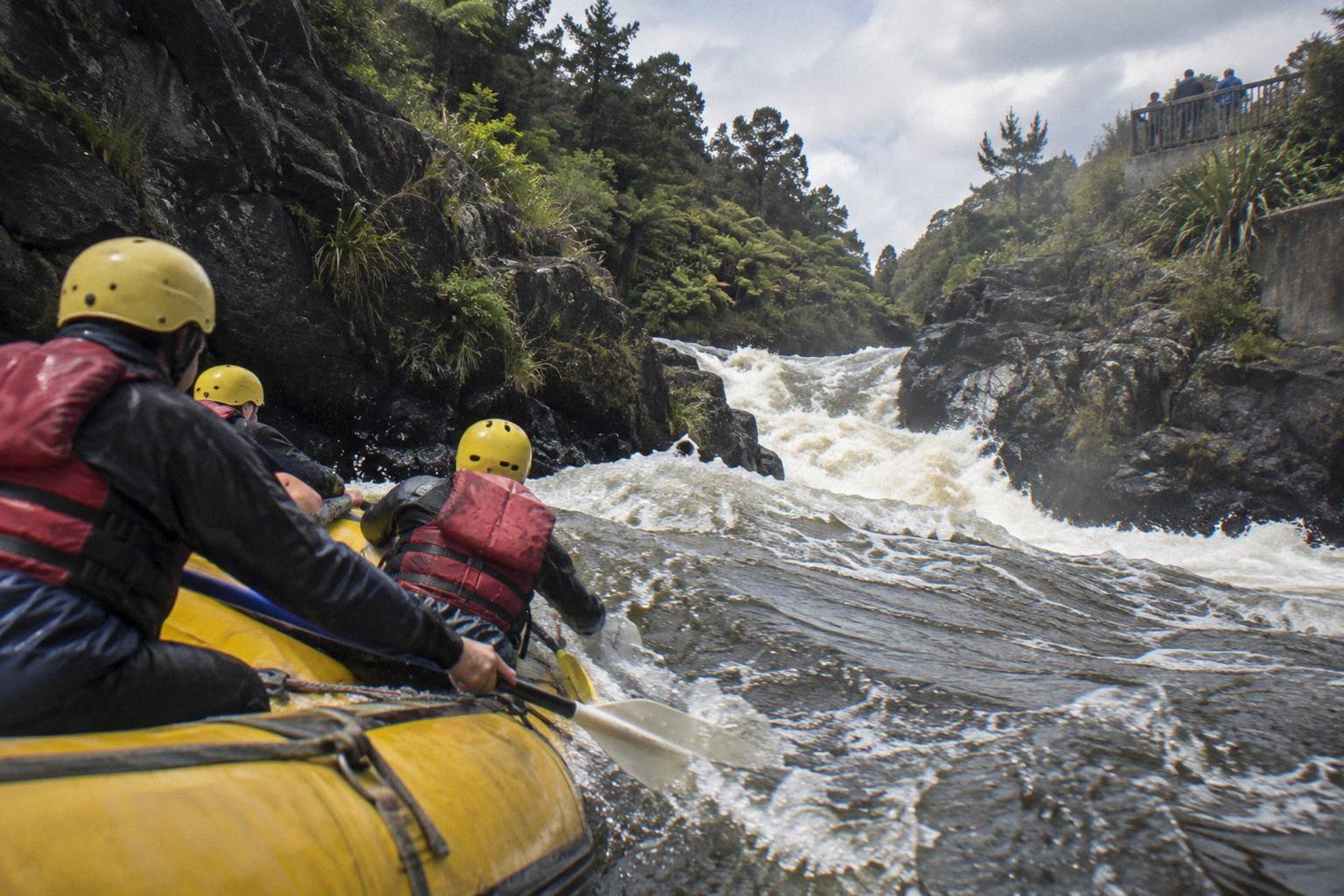
The Kaituna, as Kaituna Cascades sells it, is a Grade 5 run, and the company's own blog describes its rapids as Grade 4 and Grade 5 building to Tutea Falls. That places it two full classes above Class 3 water, never mind Class 2. The run packs 14 rapids and drops and 3 waterfalls into about 50 to 60 minutes on the water, inside a roughly 2 hour experience from the base at Okere Falls, 23 minutes from Rotorua.
Reading those numbers against the scale explains why the Kaituna has the reputation it does. A Grade 5 rapid, per the scale's own language, involves long, obstructed or violent rapids with exposed hazards, and the falls at the end of this run are a deliberate 7 metre drop, the operators' figure, which operators describe as the highest commercially rafted waterfall in the world. None of that makes the trip reckless: the run is commercially rafted year round, with council controlled gates at the Lake Rotoiti outlet holding the flow so the river runs 365 days a year.
For someone weighing Class 2 against Class 3 in the abstract, the Kaituna is a useful reality check on how far the scale extends beyond both. Several operators run it, each with their own product. The "White Water Rafting, Kaituna Cascades, The Originals" listing from Kaituna Cascades runs 2 hours, is rated 5.0 from 1,385 reviews and starts from NZ$135 per person, minimum age 13. The "Rotorua White Water Rafting, Kaitiaki Adventures + Transport" listing runs 2h30, is rated 5.0 from 823 reviews, starts from NZ$139 per person, minimum age 13, and includes free hotel pickup on that product. They are separate bookable trips and should be compared on their own details.
The Kaituna's step from Class 3 territory into Class 4 and 5 is mostly a step in consequences. The rapids before the falls are well trodden and guided, but the drop itself is the reason the minimum age sits at 13 and the maximum weight at 120 kg on the Kaituna Cascades listing. Anyone curious about the grade detail can go deeper with the Kaituna River rapids grade guide.
Choosing Between A Gentle Float And Bigger Water
Choose Class 2 when the group includes young children, non swimmers or people who want the scenery more than the adrenaline. Choose Class 3 when everyone can swim, listens to instructions and wants real waves without committing to the upper grades. If the answer needs to be one sentence: match the grade to the least confident person in the raft, not the keenest, because a terrified passenger at Class 3 sours a day that a happy float would have made.
The decision rarely exists in isolation, because it usually bends around age limits. The Grade 2 Rangitaiki listing takes children from 5. Every Kaituna listing on this site carries a minimum age of 13, and the two Rotorua Rafting sauna listings take 10. A family with an 8 year old is therefore choosing between products before they are choosing between grades: the Grade 2 trip is the one that fits.
| Your situation | Grade that fits | Example listing |
|---|---|---|
| Children under 10 | Class 2 | Grade 2 Rangitaiki listing, minimum age 5 |
| Nervous first timer, any age | Class 2 | Grade 2 Rangitaiki listing, 1.5h on water |
| Confident swimmer wanting waves | Class 3 and up | Kaituna trips, minimum age 13 |
| Family with 10 to 12 year olds | Depends on listing | Rotorua Rafting sauna listings, minimum age 10 |
| adrenaline set | Class 4 to 5 | Kaituna Grade 5, or the Wairoa on release Sundays |
Swimming ability deserves a straight answer too. Grade 2 operators can often take non swimmers, subject to their own terms, and the do you need to swim to go rafting guide covers where each trip stands. At Class 3 and above, being able to swim and being comfortable in moving water stop being optional extras and become part of the brief.
One more planning note: the calendar matters differently by river. The Kaituna runs daily thanks to the control gates, while the Wairoa, Kaituna Cascades' other Grade 5 product near Tauranga, runs only on selected Sundays when water is released. Anyone wanting big water on a specific date should check availability early rather than assume it.
What Trips People Up Before You Book
The recurring mistakes are comparing a river to a product, trusting one grade number for a whole run, and ignoring minimum ages until checkout. A river can carry several operators selling it at different grades, as the Rangitaiki does. A run can be sold at its hardest rapid, as the Kaituna is. And an age limit of 5 versus 13 decides the trip long before the waves do. Getting these three straight prevents nearly every booking mismatch.
The first trap is merging operators. The Grade 2 Rangitaiki listing belongs to Rotorua Adventures Kayak and Raft. The Grade 4 wilderness Rangitaiki trip is Kaituna Cascades'. One river, two products, two grades, two minimum ages, and a reader who blends them into "the Rangitaiki is Grade 2 or 4 depending on the website" has made the classic error.
The second trap is twin products. Several Kaitiaki Adventures trips appear as separately bookable listings with their own prices and inclusions, such as the rafting listing with hotel transfers and the Kaituna River White Water Experience at from NZ$61 per person. They are not one product at two prices, and neither is a discount off the other. Read the card that matches how you will actually arrive.
The third trap is treating the grade as the whole risk picture. Water temperature on the Kaituna runs about 24 °C in summer and about 12 °C in winter per the operator's FAQ, and operators supply wetsuits, helmets, life jackets, fleece, booties and splash jackets. A winter Class 3 trip is a colder commitment than a summer one even at an identical grade, and anyone weighing the seasons can start with whether you can go white water rafting in the winter.
The last small one: prices vary by date and group, and the booking page shows the amount for the date you select. Budgeting from a from price is fine; budgeting from someone's trip report from another season is not.
Common Questions About Rapid Grades
Is Class 3 Or Class 2 Harder Rafting?
Class 3 is harder. Class 2 rapids are straightforward with wide, clear channels and small regular waves, while Class 3 rapids bring moderate, irregular waves, narrow passages and enough turbulence to swamp a raft. Both are beginner friendly grades, but Class 3 asks for quicker reactions and real paddling on command.
Can A Beginner Run Class 3 Rapids?
Yes, Class 3 is within reach of fit, confident beginners on a guided commercial trip. The guide reads the water and calls the commands; the crew paddles hard when told. Anyone comfortable swimming and happy to be bounced around will usually manage well. The can a beginner do Class 4 rapids question covers the next step up.
Is Class 2 White Water Boring?
Not usually. Class 2 still means rapids, splashes and manoeuvring, just with wide margins for error. It is the grade most family trips run, and the Grade 2 Rangitaiki listing takes children from age 5. Boring is the wrong word for a rapid you can swim safely beside.
What Grade Is The Rangitaiki Trip?
It depends on the operator. The Rangitaiki Rafting Grade 2 listing from Rotorua Adventures Kayak and Raft is Grade 2, minimum age 5. Kaituna Cascades describes a Grade 4 wilderness trip on the same river, meeting 9:30am, running when levels and group size allow. The two should never be merged into one grade.
What Grade Is The Kaituna Run?
Kaituna Cascades sells it as Grade 5, and the company's blog describes the rapids as Grade 4 and Grade 5 building to Tutea Falls. The run covers 14 rapids and drops and 3 waterfalls in about 50 to 60 minutes on the water. Minimum ages on the Kaituna listings sit at 10 or 13 depending on the product.
Do Grades Change With Water Levels?
Yes. The scale describes rapids at normal levels, and high or low water can push a rapid a grade in either direction. Kaituna Cascades notes in its river conditions updates that high spring flows made the big waterfall more powerful though slightly less tall and vertical. Operators grade what they actually run.