White Water Rafting Tips From Guides For First-Timers
The advice that carries a first-timer through a Kaituna run is mostly unglamorous: book the right trip, wear what the operator gives you, paddle when told, and hold the rope when the guide calls it. Here is what the operator pages and standard rafting practice say, moment by moment.
Short answer
Book a trip that matches your group's ages and weight limits, ask about check-in time and what is supplied, and arrive in swimwear with a towel. On the water the working tips are simple: listen to the guide's commands, keep paddling when told, stay in the raft, and hold the rope. Operators supply wetsuits, helmets and life jackets.
If you are working out what to do on the day itself, start with the Kaituna River rafting tours hub, which lists every bookable trip on the river with its price, duration and minimum age. This page handles the layer underneath the booking: the habits and checks that separate a smooth first run from a rushed one. Most of what follows is about timing and preparation rather than courage, because that is where first-timer problems actually live.
| Fact | Detail |
|---|---|
| Typical first-timer trip | Kaituna River run from Okere Falls, sold as Grade 5 (Class V) |
| Time on the water | 50 to 60 minutes, inside an experience of about 2 hours (Kaituna Cascades) |
| What the run holds | 14 rapids and drops and 3 waterfalls (Kaituna Cascades) |
| Kit operators list | Wetsuits, helmets, life jackets, fleece, booties, splash jacket |
| What to bring | Swimwear and a towel (Kaituna Cascades) |
| Sample price | From NZ$135 per person for the "Free Sauna, 2h30 Kaituna Trip" by Rotorua Rafting |
| Sample entry age | Minimum age 10 on the Rotorua Rafting sauna listings; 13 on the Kaituna Cascades and Kaitiaki listings |
| Water temperature | About 24 °C in summer, about 12 °C in winter (Rotorua Rafting FAQ) |
All money figures in this article are New Zealand dollars, and each price belongs to one product only. Prices vary by date and group, and the booking page shows the price for the date. Nothing here promises conditions on the day: weather, river flow, the operator and the booking calendar decide what runs.
What Actually Matters On A First Rafting Trip
The tips that change your day are booking-level ones: matching the trip to your group's ages and weights, arriving with the right clothing, and checking in early enough to suit up without rushing. Once on the water, the list shortens to four habits: listen to the guide's commands, paddle when told, stay in the raft, and hold the rope when it is called. Everything else is detail that follows from those.
Standard rafting practice, as described in the Wikipedia entry on rafting, puts the guide in charge of the paddle commands and the crew in charge of responding to them quickly and together. That division of labour is the whole engine of a raft: a boat of six people paddling in sync on command moves where the guide wants it, and the same boat paddling at half attention does not. No operator page promises a dry or calm trip, and none should; what they do promise is equipment, a briefing, and a guide who has run the river many times before you got in.
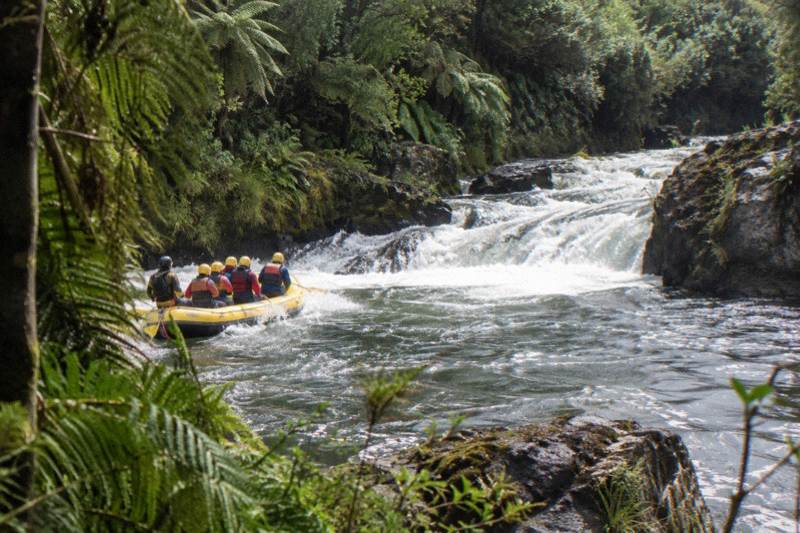
The Kaituna makes a good classroom for this because the run is compact. Kaituna Cascades describes about 50 to 60 minutes on the water inside an experience of about 2 hours, with 14 rapids and drops and 3 waterfalls, sold as Grade 5 with rapids the operator's blog calls Grade 4 and 5 building to the falls. First-timers are normal on this river, which is why the briefing covers everything you need before the boat leaves the bank. If you want the full picture of the run itself, the what happens on a Kaituna rafting trip guide walks through it stage by stage, and this page stays on the habits.
One framing tip before the detail: read advice as advice, not as a guarantee. The difference between a good first run and a stressful one rarely comes down to athleticism. It comes down to whether the booking matched the group, whether everyone arrived with the right clothing, and whether the crew treated the briefing as the start of the trip rather than a formality before it. Get those three right and the water takes care of itself, because the guide's instructions cover the rest.
What To Ask Before You Book
Ask four questions before you pay: what the minimum age and maximum weight are on that specific trip, what time check-in is, what the operator supplies, and what the cancellation terms are. Each of these is stated per product, not per operator, and the differences between trips run by the same crew can matter more than the differences between crews. Ages and weights especially can rule a person in or out on the spot.
The per-product point is worth dwelling on. On the Kaituna, the Rotorua Rafting sauna listings show a minimum age of 10 on those listings, while Kaituna Cascades sets a minimum age of 13 with ages 10 to 12 joining halfway along the run, and Kaitiaki Adventures sets a minimum age of 13. These are listing-level figures, not operator-wide rules, so check the trip you are actually booking. Weight follows the same pattern: Kaituna Cascades states a maximum of 120 kg and Rotorua Rafting a maximum of 130 kg.
| Question to ask | Why it matters | Where the answer sits |
|---|---|---|
| Minimum age on this trip | Ages differ between listings on the same river | Operator terms and the booking page |
| Maximum weight | 120 kg on Kaituna Cascades, 130 kg on Rotorua Rafting | Operator terms |
| Check-in time | Kaituna Cascades asks 15 minutes early | Operator terms |
| What is supplied | Wetsuit, helmet, life jacket, fleece, booties, splash jacket on the stated pages | Operator pages |
| Cancellation terms | Weather and flow can change plans | The booking page |
| Swim requirement | Some trips must be swum; ask the operator | Operator terms |
| Pickup arrangements | Free hotel pickup belongs to Kaitiaki Adventures, on all four of its listings | Product page |
Health conditions belong on this list too. Kaituna Cascades states its trips are not for pregnancy or heart conditions, and a float test may be required. If anyone in your group has a condition worth mentioning, ask the operator directly before booking rather than assuming a blanket rule exists either way. The same goes for anything unusual: a large group, a birthday, a nervous swimmer, a photographer. Operators answer these questions constantly, and an answer before payment beats a surprise at check-in.
If comparing crews is the stage you are at, the Kaituna rafting operators compared guide sets out the differences side by side. When you have a shortlist, check the live price for your date; the calendar holds it. The trips below are three solid first-timer options on the river.
What To Wear And What The Operator Supplies
You supply swimwear and a towel; the operator supplies the rest of the kit. The Rotorua Rafting and Kaituna Cascades pages list wetsuits, helmets, life jackets, fleece, booties and a splash jacket as supplied, which covers the whole body except what goes under the wetsuit. Wear swimwear underneath, skip cotton entirely, and bring a towel for after the run.
The no-cotton rule is standard practice: cotton holds water and loses its insulation when wet, which is the opposite of what you want in water that Rotorua Rafting's FAQ describes as about 24 °C in summer and about 12 °C in winter. Swimwear or a synthetic base layer under the wetsuit does the job. Jewellery and loose items stay on land, and glasses need a strap if they come at all; Rotorua Rafting allows GoPro mounts on its trips, so ask about camera arrangements rather than improvising one.
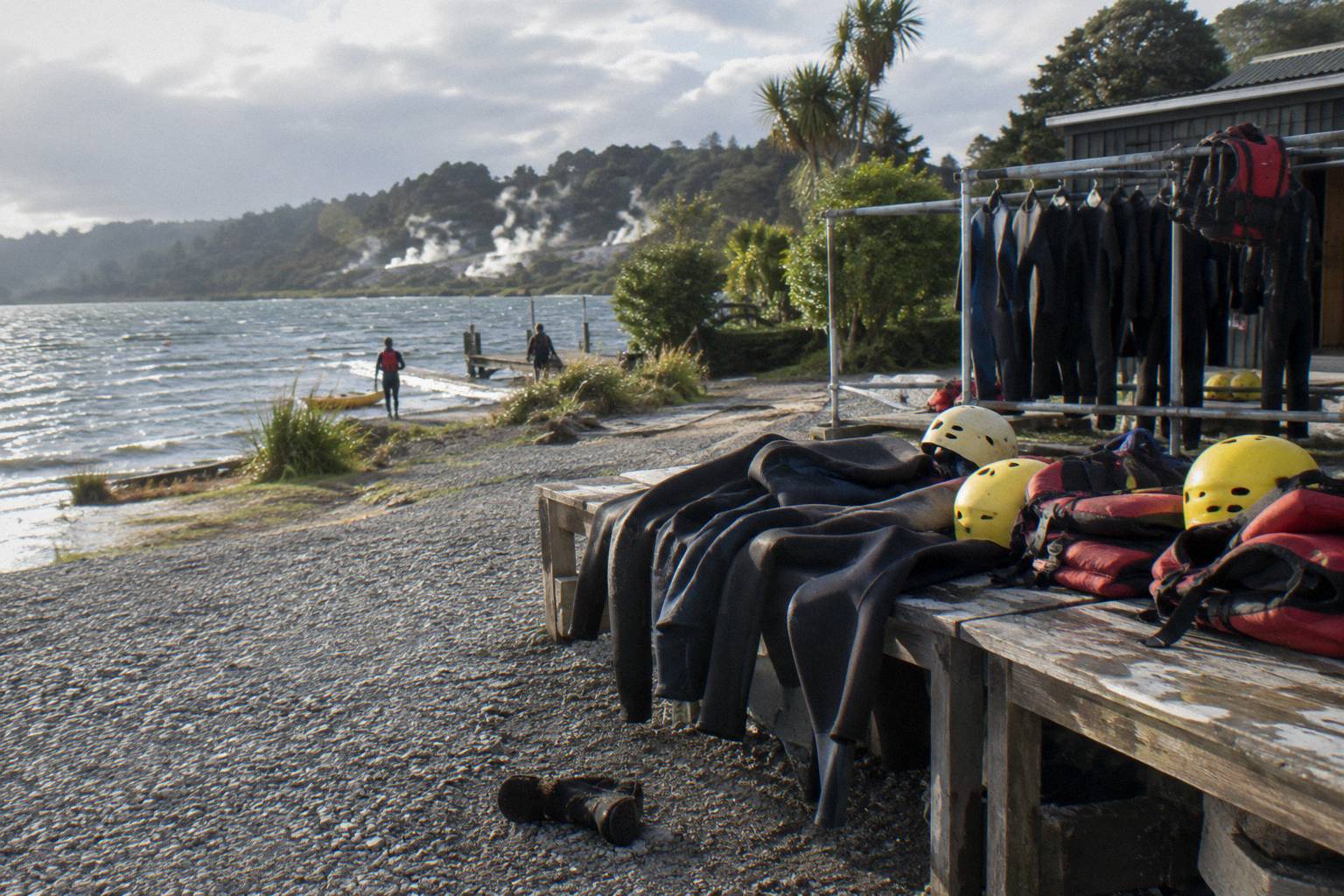
Footwear catches first-timers out. You do not need river shoes of your own on the trips that supply booties, but ask when booking if the page does not mention footwear, because a thin sole matters on gravel banks. The fuller packing picture, including what to leave in the car and what to do with valuables, is in the what to wear white water rafting guide and the companion what to bring guide.
| Kit item | Who lists it as supplied | What it does for a first-timer |
|---|---|---|
| Wetsuit | Rotorua Rafting and Kaituna Cascades pages | Holds warmth in 12 to 24 °C water |
| Helmet | Rotorua Rafting and Kaituna Cascades pages | Head protection through drops |
| Life jacket | Rotorua Rafting and Kaituna Cascades pages | Buoyancy in and out of the raft |
| Fleece | Rotorua Rafting and Kaituna Cascades pages | Extra insulation under the wetsuit |
| Booties | Rotorua Rafting and Kaituna Cascades pages | Grip and protection on gravel |
| Splash jacket | Rotorua Rafting and Kaituna Cascades pages | Cuts wind and splash chill |
| Swimwear and towel | You bring these (Kaituna Cascades) | Base layer and warmth after the run |
One clothing tip people miss: check in early enough to change properly. Kaituna Cascades asks for check-in 15 minutes before departure, and suiting up unhurried beats arriving in the last minute and missing the briefing. That briefing is where the paddle commands are taught, and it is the single most useful five minutes of the day.
Safety in New Zealand operates under a formal regime rather than goodwill: adventure activity operators must pass a safety audit by a WorkSafe-recognised auditor and appear on the WorkSafe adventure activities register, under the Adventure Activities Regulations 2016. You can look a crew up on the register before you book, and it takes a minute. The regime exists precisely so that a first-timer does not have to audit a rafting company themselves.
On The Water: Commands, Paddling And Holding On
Four instructions carry the whole run: listen to the guide's commands, paddle when told and stop when told, stay in the raft, and hold the rope when the guide calls it. The commands are taught on the bank before launch, they are few in number, and the crew's job is to respond together and immediately rather than to think about the rapid.
The paddle commands are the vocabulary of the trip. The standard set, described in general terms in the Wikipedia entry on whitewater sports and rapid grades, involves forward paddling, back paddling, stopping, and leaning or bracing in a direction on command. The guide calls them early, before the rapid rather than inside it, which is why a crew that listens lands better than a crew that watches the scenery. Sync matters more than power: six people paddling at the same instant beat six people paddling hard at six different instants.
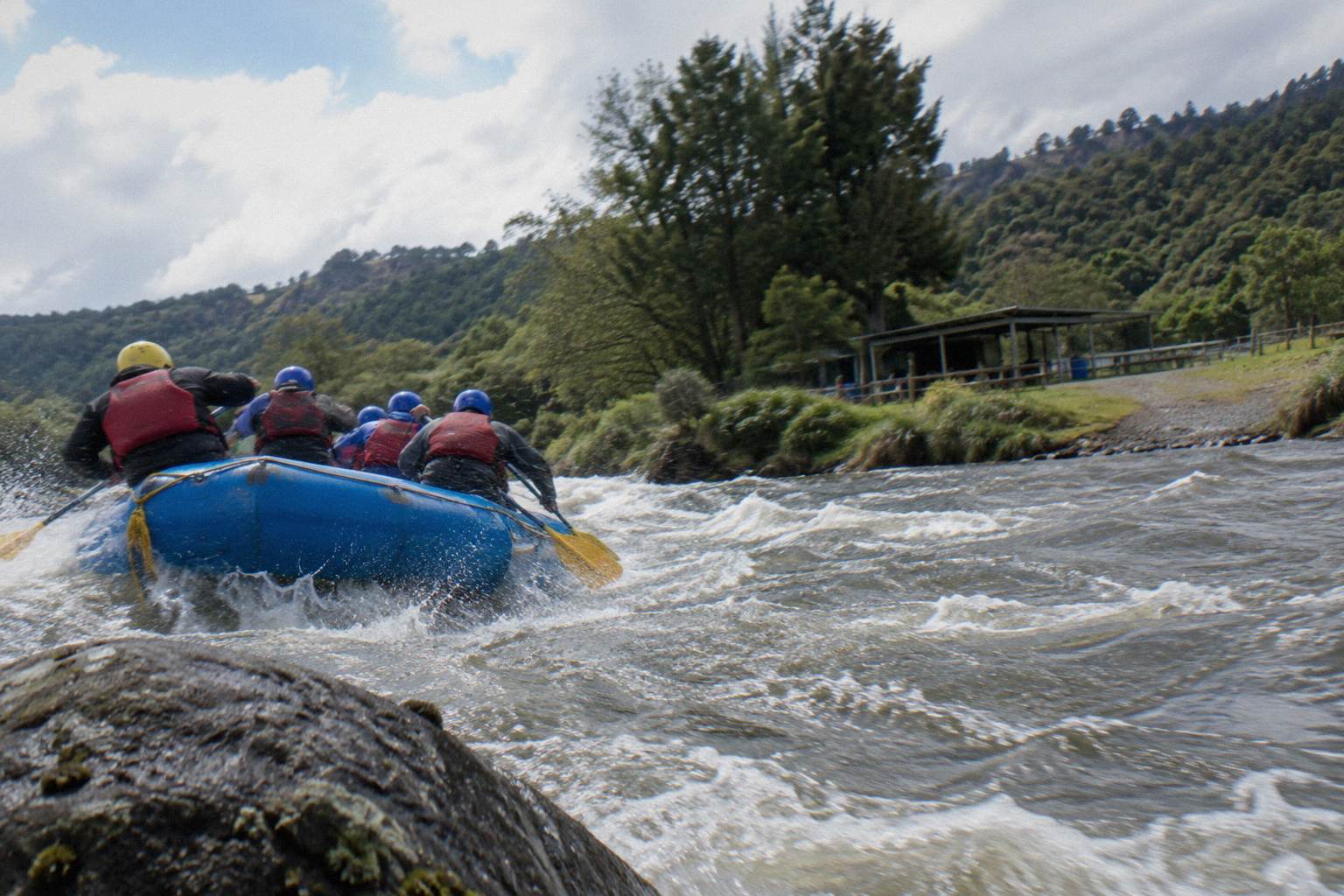
The rope, in this context, is the perimeter line running around the outside of the raft. Holding the rope when told, and keeping it there through the drops, is how you stay attached to the boat through the biggest features. Tucking low and holding on at the waterfalls is the position the briefing teaches. If you want the full picture of what a swim looks like and how the recovery works, read what happens if you fall out of the raft separately; the short version for a first-timer is that the guide's instructions before and during the run are the ones to follow, not improvisation.
Fear management is the last piece. First-timers who enjoy the run tend to be the ones who decided in advance to trust the commands and treat the briefing as the whole job. The Kaituna has the advantage of being runnable 365 days a year, because council-controlled gates at the Lake Rotoiti outlet hold the flow, so the river you trained your expectations on in summer is recognisably the same river in winter, only colder. A well-fitted lifejacket and helmet, adjusted at the base before launch, are part of the same posture: sort the equipment on land so that nothing on the water needs thinking about.
Tips By Moment Of The Run
The right tip changes with the moment: booking decisions dominate the week before, clothing and check-in dominate the hour before, commands dominate the minutes on the water, and warmth dominates the hour after. Grouping advice by moment keeps you from applying the right tip at the wrong time, which is the most common first-timer error after arriving late.
| Moment | The tip that matters | Why |
|---|---|---|
| Booking | Match ages and weights to the listing's own limits | Limits are per product, not per operator |
| Week before | Check the weather and flow situation, not forecasts of drama | Flow changes the run's character, not its existence |
| The drive | Leave for Okere Falls with margin | Bases sit 18 to 23 minutes from Rotorua |
| Check-in | Arrive 15 minutes early where asked | Suiting up and the briefing both take time |
| The briefing | Learn the commands and repeat them mentally | Commands are few and used constantly |
| Flat water | Practise the paddle stroke in sync | Sync is built before the first rapid |
| Rapids | Paddle on command, keep the stroke going | Stopping mid-rapid is the common mistake |
| The waterfalls | Hold the rope, tuck low as briefed | The briefed position is the stable one |
| After the run | Towel, dry clothes, warm layer immediately | Body heat drops fast once you stop moving |
Two rows deserve a sentence each. The drive matters more than it looks: the bases cluster around Okere Falls, with Kaituna Cascades on Okere Falls Road and Rotorua Rafting on State Highway 33, and a missed check-in can mean a missed trip rather than a late one. And the after-run row is the one first-timers forget entirely: the moment you stop paddling, you stop generating heat, and the towel you were told to bring becomes the most valuable object you own. The Kaitiaki transfer products exist partly for this reason, with free hotel pickup on those two listings, which removes the cold, wet drive entirely.
Reading The River: Grades, Flow And What Changes
A rapid's grade describes its difficulty on the International Scale of River Difficulty, and the Kaituna is sold as Grade 5 while its rapids are Grade 4 and 5 building to the falls. Flow changes the character of those rapids day to day, and on the Kaituna the council-controlled gates at the Lake Rotoiti outlet keep the river runnable year round, so the question is never whether it runs but what shape it is in.
For a first-timer, the practical use of grades is calibration, not courage-testing. Knowing the trip is sold as Grade 5 tells you the briefing will be thorough and the guide's positioning will be deliberate; knowing the rapids build from Grade 4 tells you the run gets harder rather than starting at its peak. The scale itself, from easy moving water to extreme rapids, is laid out in the Wikipedia whitewater entry's grade table, and the site's own rapid grades explained guide covers it in rafting terms.
Flow is the quieter variable. A spring update from Kaituna Cascades described flows high at "500s on the control gates" with water at 19 degrees C, and the big waterfall "more powerful but slightly less tall and vertical" at those levels. That is the kind of sentence worth reading twice: the same rapid can be a different experience month to month, and the operator's own river conditions page is where that shape is described before you go. Ask the crew on the day what the river is doing; it is a fair question and they answer it constantly.
None of this requires you to become a hydrologist. The first-timer's version is: know the grade you booked, know that flow changes character, and let the guide make every judgement call on the water. If a harder river is on your mind later, the Wairoa River rafting guide covers a Grade 5 run that operates only on selected Sundays when water is released, which is a different kind of trip altogether.
What Trips People Up Before You Book
Most first-timer problems happen before the raft touches water: booking a trip whose age or weight limits exclude someone in the group, arriving without swimwear and a towel, treating check-in as the departure time, or assuming kit or pickup terms that belong to a different product. Each of these is a two-minute check at booking time, and each one is a day-derailer if skipped.
The twin-product trap is the subtle one. Several Kaituna trips on the booking pages are separate bookable products with their own prices and terms, including shorter and longer versions of near-identical runs. Treat them as separate trips: compare what each includes, not just the from-price. For example, the "Free Sauna, 2h Kaituna Run" by Rotorua Rafting is from NZ$74 per person for a 2 hour trip, while its 2h30 twin, the "Free Sauna, 2h30 Kaituna Trip", is from NZ$135 per person on its own card; those are two products, not one trip at two prices.
The other recurring mistakes are simpler. Wearing cotton under the wetsuit, which stays cold and wet all run. Skipping the briefing because it repeats what you read online, and then missing the command vocabulary. Assuming pickup is included everywhere because it is included on the Kaitiaki transfer listings, where free hotel pickup belongs to those two products only, while Rotorua Rafting offers an optional paid pickup you can add. And assuming winter is off-season: Rotorua Rafting runs three trips a day from 1 May to 31 August at 10, 12 and 2, and six or more in summer from 1 September to 30 April, so the calendar is full year round.
Finally, do not over-plan the day around a fixed end time. The whole experience runs about 2 hours on the standard Kaituna trips, but a big group, a change of flow or a slower shuttle moves the finish. Book the first slot of the day if you have somewhere to be, and give yourself a margin after. See dates on the calendar before you promise anyone a precise pickup time.
The three trips below are the same three from the top of the page, gathered here for the decision. Each is a separate product with its own price, duration and minimum age, and the booking page shows the price for the date you have in mind. Check availability before you build the rest of the day around a time.
Common Questions About First-Time Rafting
Is White Water Rafting Hard For First-Timers?
The Kaituna run is designed to take first-timers: the briefing teaches the paddle commands on the bank, the guide calls every instruction during the run, and the operators supply the full kit. The physical demand is paddling in short bursts and holding position, not sustained effort. Kaituna Cascades describes 50 to 60 minutes on the water, and a float test may be required.
What Should A First-Timer Wear Rafting?
Swimwear under the wetsuit, with a towel for after. The Rotorua Rafting and Kaituna Cascades pages list wetsuits, helmets, life jackets, fleece, booties and a splash jacket as supplied, so your own clothing job is the layer next to skin plus dry clothes for the end. Avoid cotton, which stays cold and wet.
What Are The Four Main Tips For Staying In The Raft?
Listen to the guide's commands, keep paddling when told, stay in the raft, and hold the rope when the guide calls it. Those four instructions come from the operators' own briefing practice, and they cover the run from put-in to take-out. The commands are taught before launch and repeated on the water.
How Early Should You Arrive For A Rafting Trip?
Kaituna Cascades asks customers to check in 15 minutes before departure. Suiting up and the safety briefing both happen in that window, and a missed briefing can mean missing the trip. If you are driving out from town, the bases sit 18 to 23 minutes from Rotorua depending on the operator.
Do You Need To Be Able To Swim To Go Rafting?
It depends on the trip: the Wairoa product states you must swim, and a float test may be required on Kaituna Cascades trips. Life jackets are supplied on the listed products and the briefing covers what to do in the water. Ask the operator about the specific trip before booking, since terms differ between products.
Can You Bring A Camera On A White Water Rafting Trip?
Rotorua Rafting allows GoPro mounts on its trips. Loose cameras and phones are a different question, and the safest answer is to ask the operator about the specific trip when booking. Anything not attached stays on land or in the car with your dry clothes and towel.
One more planning step: if the day around the trip is still open, the one day built around a rafting trip guide sequences everything else, and the Free Sauna Kaituna trip page holds the details for the trip most first-timers land on. Both live on Rafting Rotorua alongside the operator and season guides.